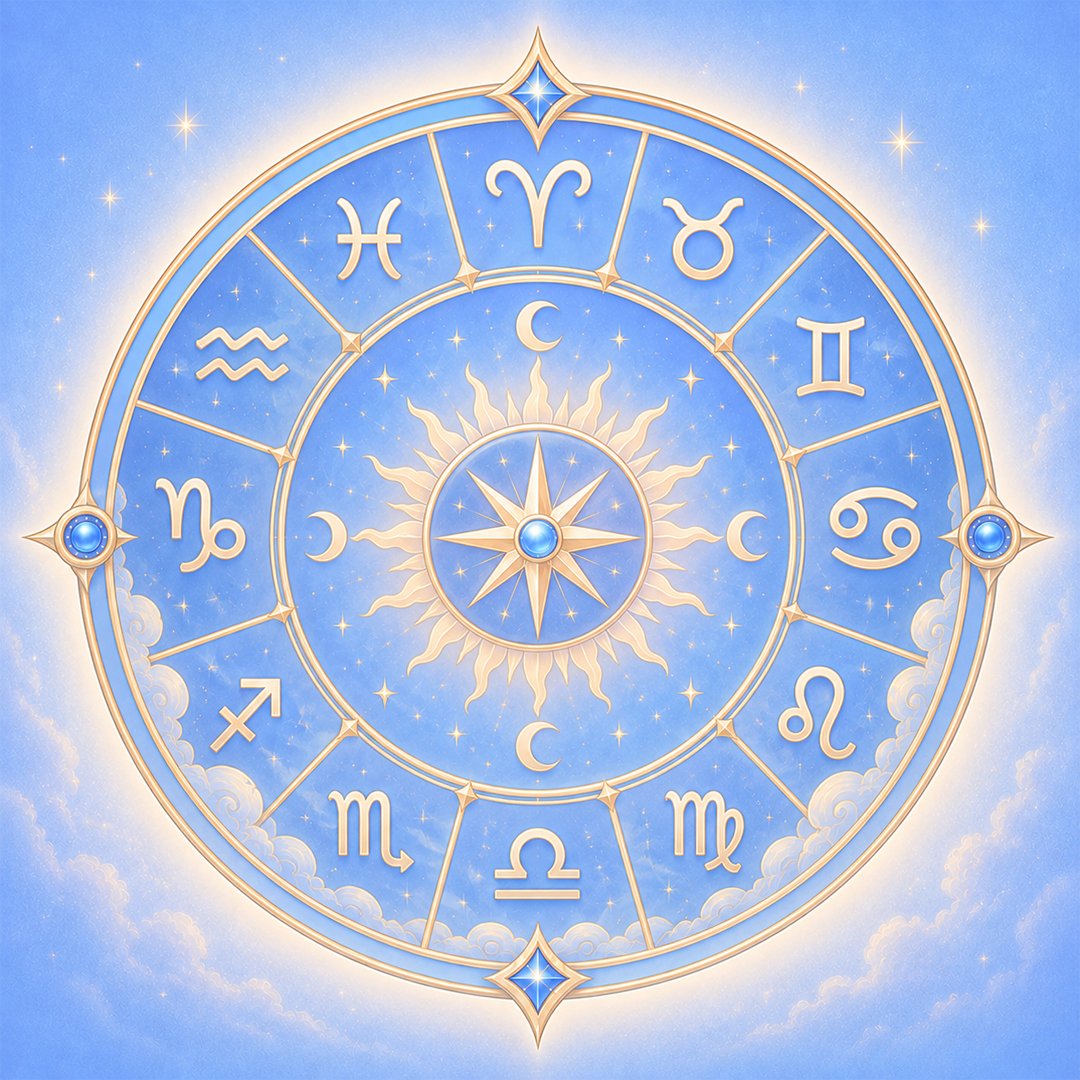
Your Dominant Element Is Probably Not Your Sun Sign’s
Everybody knows their Sun’s element. Aries is fire, Taurus is earth, and so on around the wheel. What far fewer people know is that the element leading their actual chart is frequently a different one — and that the discrepancy explains a great deal of the “this description does not sound like me” problem.
A chart has ten bodies plus two angles. The Sun is one of them. Counting all of them produces a distribution, and distributions are more informative than single points.
The four elements as four operating modes
Before counting, it helps to have a working definition of each element that is specific enough to be falsifiable.
Fire — Aries, Leo, Sagittarius — is initiative. It supplies momentum, self-belief and the willingness to act before all the information arrives. Its failure mode is starting more than it finishes.
Earth — Taurus, Virgo, Capricorn — is consolidation. It supplies patience, realism about cost and the ability to build something that lasts. Its failure mode is resisting change past the point where change was needed.
Air — Gemini, Libra, Aquarius — is perspective. It supplies analysis, fairness and the ability to hold an idea at arm’s length. Its failure mode is thinking about a feeling instead of having it.
Water — Cancer, Scorpio, Pisces — is attunement. It supplies empathy, emotional memory and the ability to read what is not said. Its failure mode is absorbing moods that were never theirs.
Not all placements count equally
A raw count of ten bodies would be misleading, because the outer planets move so slowly that everybody born in the same few years shares them. Pluto sits in one sign for over a decade. Treating it as equal to the Moon would mean an entire generation had the same elemental balance, which is obviously useless.
So the standard approach weights by how personal a placement is. The Sun, Moon and ascendant carry the most weight. Mercury, Venus and Mars carry a moderate amount — they move fast enough to differ between people born the same month. Jupiter and Saturn carry a little. Uranus, Neptune and Pluto carry very little for individual purposes, because they describe a cohort rather than a person.
Our Element Balance calculator applies exactly this weighting. Enter whichever placements you know — it does not require all of them — and the percentages adjust to what you actually supplied rather than assuming the rest.
The missing element is the interesting one
Most people reading about elements look for their dominant one. The tradition is generally more interested in the absent one, and for a defensible reason: a dominant element describes a strength somebody already has and already uses. An absent one describes a mode that has to be built deliberately, because it will never arrive by instinct.
A chart with no earth tends to struggle with the practical layer of its own plans — not from incapacity, but because the practical layer never occurs to it unprompted. A chart with no water can find emotional register genuinely difficult to access, in themselves as much as in others. No air can mean difficulty getting distance from a situation to see it plainly. No fire can mean everything is considered and very little is begun.
None of these is a defect. The useful framing is that an absent element names the thing to build a habit around, because it is the one place instinct will not help.
Stelliums and the opposite problem
The reverse case is a heavy concentration — four or five placements in one element, sometimes in one sign. This is a genuine intensity, and the tradition reads it as a chart with no internal counterweight.
A heavily fire chart has nothing in it that naturally says wait. A heavily water chart has nothing that naturally says step back. The strength is real and so is the blind spot, and unlike a missing element there is no obvious external prompt to correct it, because everything in the chart agrees with itself.
What to do with the number
The practical use of an element count is not self-description; it is deciding which correction is worth the effort.
If earth is missing, the fix is structural rather than motivational — automatic transfers rather than intentions to save, calendar entries rather than mental notes. If water is missing, the fix is deliberate check-ins rather than waiting to notice a feeling. If fire is missing, the fix is a smaller first step, chosen in advance so that starting does not require enthusiasm.
The count is worth running properly rather than estimating. If you know your Sun, Moon and rising, that is already enough for a reasonable weighting; adding Mercury, Venus and Mars sharpens it considerably. For the full set computed from your birth details, the star map produces every placement at once, and the elements section of the almanac covers what each one traditionally governs in more depth.