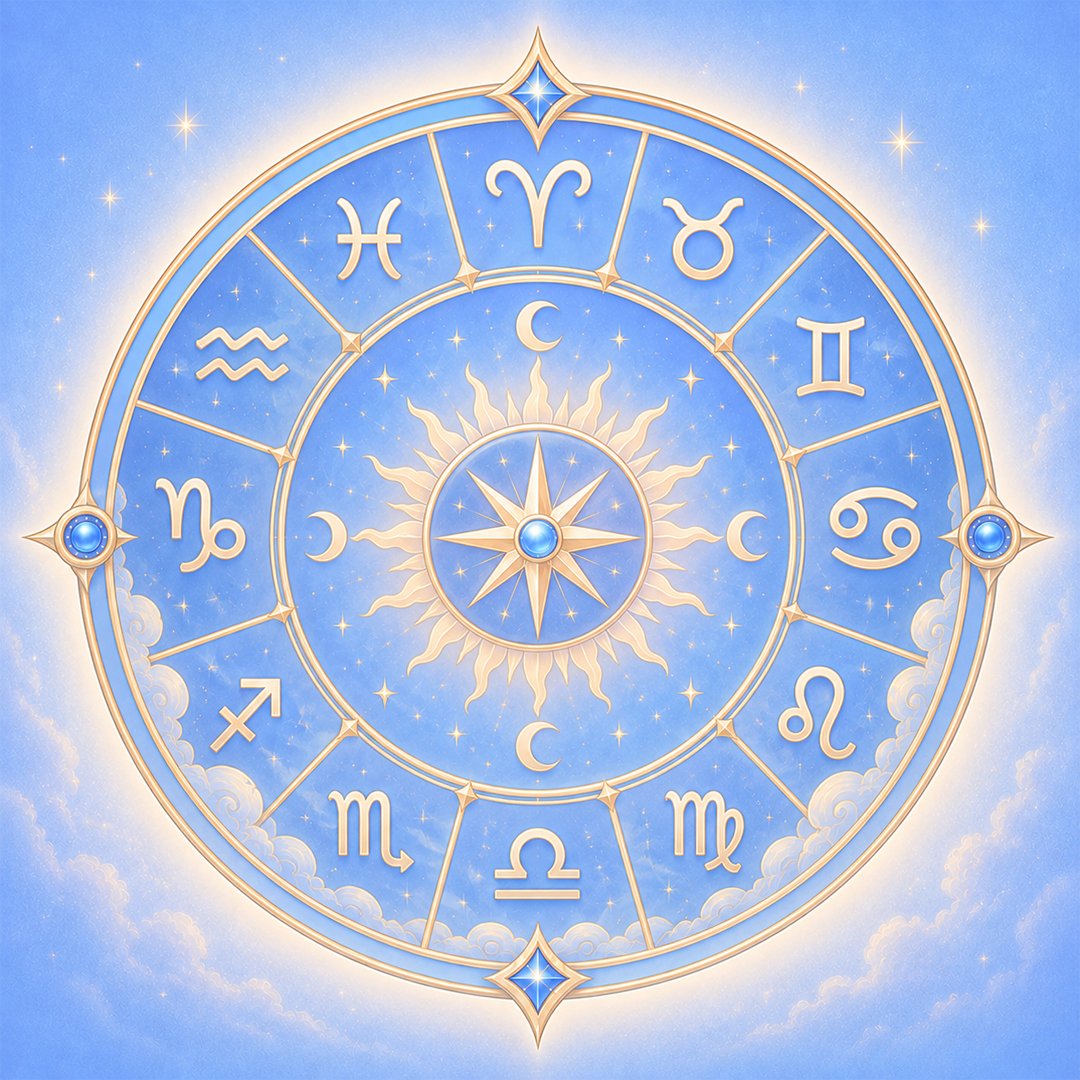
The Twelve Houses, Explained Without the Jargon
Beginners usually learn signs first, then planets, and then hit the houses and stall. The stall is predictable, because houses are taught as a list of twelve topics to memorise and that is genuinely hard to retain.
The list is much easier to hold once you know what the houses are for, and the answer is short: signs and planets describe a manner and a function, and houses describe the area of life where it plays out.
The sentence that makes it click
A chart reads as a sentence with three parts.
The planet is the verb — what is happening. Venus is attraction and values. Mars is drive. Mercury is thinking and communicating.
The sign is the adverb — how it happens. Venus in Capricorn attracts and values cautiously, durably, with an eye on the long term.
The house is where it happens. Venus in Capricorn in the tenth house puts that cautious, durable valuing into the area of career and public standing. The same planet in the same sign in the fourth house puts it into home and family instead, and that is a very different life.
Planet, sign, house. Once the sentence structure is in place, the twelve topics stop being a list to memorise and become slots the sentence can end in.
The twelve, briefly
The first house is self and approach — the ascendant sits here, and it governs how you meet anything new.
The second is resources and worth: money, possessions, and what you consider valuable.
The third is immediate communication — siblings, short journeys, everyday exchange of information.
The fourth is home, family and roots. The private base a life is run from.
The fifth is creativity, play, romance and children — output made for its own sake.
The sixth is work, routine and health. The daily maintenance layer.
The seventh is partnership: marriage, close alliances, and open opposition, which the tradition treats as the same axis viewed from either end.
The eighth is shared resources and transformation — joint finances, inheritance, and what changes irreversibly.
The ninth is meaning and distance: philosophy, higher study, long travel, belief.
The tenth is career and public standing. The midheaven sits here.
The eleventh is community, friendship and the future — groups and long-range hopes.
The twelfth is solitude, the unconscious and what operates out of sight.
The four angles carry the most weight
The houses are not equally loud. The first, fourth, seventh and tenth begin at the four angles of the chart, and placements there are traditionally read as more prominent than the same placement elsewhere.
These four also form two axes rather than four separate topics: self against partnership on the first-seventh line, private base against public standing on the fourth-tenth. Reading them as pairs is more informative than reading them singly, because each pair describes a balance somebody is negotiating rather than two unrelated areas.
Empty houses are not empty lives
Ten bodies distributed across twelve houses means at least two houses have nothing in them, and usually more. This alarms beginners regularly, and it should not.
An empty seventh house does not mean no relationships. It means that area is not where the chart’s particular tensions concentrate — it runs on the sign on its cusp and the condition of that sign’s ruler, without a planet sitting in it demanding attention. The tradition reads a planet in a house as emphasis, not as permission.
Why houses need a birth time
Here is the practical catch. The houses are anchored to the ascendant, and the ascendant moves through the whole zodiac every twenty-four hours — roughly one sign every two hours.
That means a two-hour error in birth time can shift every house boundary by a full sign, relocating most of your placements into different areas of life. Signs and planets survive an unknown birth time reasonably well. Houses do not survive it at all.
If you have an accurate hour, our star map calculator computes the full house structure along with all ten bodies and both angles, and runs entirely in your browser. If you do not, the placements themselves are still worth knowing — the Element Balance calculator works fine without houses, and the houses section of the almanac covers each one in more depth for when you do track the time down.